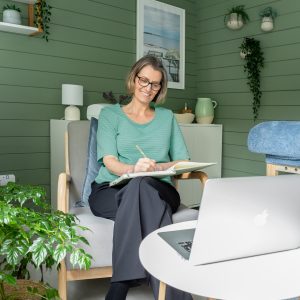
When was the last time you had an hour where you didn’t need to do anything for anyone else?
No emails to answer. No jobs to finish. No one asking what’s for dinner. Just some time to sit back, switch off and have someone else look after you.
For many women, that’s one of the things they enjoy most about reflexology. Once you’re comfortably settled on the treatment couch, there’s nowhere else you need to be and nothing you need to do. You can simply relax and enjoy the experience…. Bliss
And while reflexology has traditionally been used for wellbeing and relaxation, there is also growing research exploring whether it may have benefits for people experiencing menopausal symptoms.
So, can reflexology actually help with stress and relaxation? And what does the research tell us?
What is Reflexology?
Reflexology is a complementary therapy involving massage and pressure techniques applied to the feet.
It is based on the theory that particular areas of the feet correspond with different parts of the body.
People choose reflexology for different reasons. Some value the opportunity to slow down, whilst others view it as an integral part of their wellbeing and others simply like having dedicated time to themselves.
It is worth being clear, though, about the difference between the traditional principles of reflexology and what scientific research has demonstrated.
There isn’t strong scientific evidence that pressing a particular point on the foot directly affects a specific internal organ.
That doesn’t mean the experience of reflexology can’t feel relaxing or contribute to someone’s sense of wellbeing. It simply means we need to be realistic about what the evidence does and doesn’t tell us.
Why might Reflexology feel relaxing?
A reflexology treatment gives you something that can be surprisingly difficult to find in everyday life:
Time to stop.
- You’re lying down comfortably.
- You’re not answering emails.
- You’re not doing the dishes, the washing, the ironing, the cleaning.
- You’re not thinking about what’s for dinner.
For a while, someone else is looking after you.
The experience of receiving massage and touch in a calm environment may itself feel relaxing, and having dedicated time away from everyday responsibilities can be valuable.
And perhaps there’s something else going on too.
When we are constantly busy, we can become very good at being in “doing mode”. We move from one task to the next without really noticing how we’re feeling, physically and emotionally.
A reflexology treatment gives you permission to step out of that for a while.
- You don’t have to achieve anything.
- You don’t have to be productive.
- You can simply be there.
What about Perimenopause and Menopause?
This is particularly interesting because perimenopause and menopause can be a time when life feels very full.
You may be managing work, family responsibilities, changing sleep, hot flushes, fatigue, brain fog, changes in mood and all the usual demands of everyday life at the same time.
The NHS recognises that menopause symptoms can affect everyday life and suggests looking after your mental wellbeing and finding ways to relax.
For some women, making time for themselves can become something that keeps getting pushed to the bottom of the list.
A reflexology appointment can provide a reason to stop.
And you don’t have to wait until you’re completely overwhelmed before you make time for yourself.
What does the research say?
There is now a systematic review and meta-analysis specifically looking at foot reflexology and menopausal symptoms.
Published in Current Women’s Health Reviews in 2025, the review looked at studies investigating whether foot reflexology could help women experiencing menopausal symptoms.
The researchers identified eight relevant studies, with six included in the meta-analysis.
They found that foot reflexology was associated with a statistically significant reduction in overall menopausal symptoms.
They also found a statistically significant reduction in fatigue.
However, the researchers did not find statistically significant improvements in anxiety or depression compared with the control groups.
There is an important caveat.
The researchers assessed the certainty of the evidence as low for overall menopausal symptoms and very low for fatigue, anxiety and depression. They concluded that more high-quality research is needed before firm conclusions can be drawn.
So, this is encouraging research, but it isn’t proof that reflexology will reduce menopause symptoms for every woman.
And that’s an important distinction.
Promising isn’t the same as proven.
Here is what one of my clients had to say…
“You must book a session with Helen! Her ability as a therapist is exceptional. As a yoga practitioner, I knew the second Helen tapped into my central nervous system using her reflexology techniques, it happened early in the session and felt fantastic. I felt calm, grounded and completely relaxed. And by the hour’s end, it felt like I’d had a full-body massage. It was wonderful – a great antidote for a busy life. I’ll definitely be back again!”
J from Falmouth
What might this mean for you?
If you’re experiencing perimenopause or menopause symptoms, reflexology could be one part of a wider approach to looking after yourself.
- You might simply enjoy the treatment.
- You might appreciate having some uninterrupted time to yourself.
- You might find the experience relaxing.
And there is some emerging research suggesting that foot reflexology may help with overall menopausal symptoms and fatigue.
What I wouldn’t suggest is booking a reflexology treatment because someone has promised it will “balance your hormones” or fix your menopause symptoms.
Those claims go beyond the current evidence.
Instead, think of reflexology as one possible part of your overall wellbeing.
Instead of asking:
“Will reflexology fix my stress?”
Perhaps ask:
“Would I benefit from having some time where I don’t have to fix or do anything?”
For many people, that’s a much more realistic reason to book a treatment.
You don’t have to wait until you’re completely exhausted before you give yourself permission to stop.
Taking an hour for yourself isn’t selfish.
It doesn’t mean you’re neglecting everyone else.
Sometimes it’s simply a chance to pause.
And perhaps you’ll leave feeling a little more relaxed, a little more refreshed and ready to get on with the rest of your day.
Reflexology as part of your wellbeing
Reflexology is a complementary therapy and shouldn’t replace appropriate medical care.
If you’re experiencing persistent anxiety, low mood, sleep problems, significant fatigue or other symptoms that are affecting your everyday life, it’s worth speaking to your GP or another appropriate healthcare professional.
You can then decide whether complementary therapies such as reflexology are something you’d like to include alongside that support.
For me, reflexology isn’t about promising to fix everything.
It’s about providing a space where you can stop for a while, switch off and have some time that’s just for you.
Sometimes you don’t need another thing to achieve.
You just need an hour to stop.
The evidence at a glance
A 2025 systematic review and meta-analysis found that foot reflexology was associated with improvements in overall menopausal symptoms and fatigue.
However, the researchers rated the certainty of the evidence as low or very low and recommended further high-quality research.
The review did not find a statistically significant effect on anxiety or depression.
So the fairest conclusion is that reflexology shows some promising evidence as a complementary approach for menopausal symptoms, but we don’t yet have strong enough evidence to say that it treats menopause or specific symptoms.
Research reference
Maghalian M, Alikamali M, Aslanpur F, Mirghafourvand M. Foot Reflexology for Managing Menopausal Symptoms in Women: A Systematic Review and Meta-Analysis. Current Women’s Health Reviews. 2025;21(5).
Please note: Hypnotherapy and reflexology are complementary therapies and are not a substitute for medical advice or treatment. If you’re experiencing new, severe or concerning symptoms, speak with your GP or another appropriately qualified healthcare professional.